What painting above the bed
It's the only wall in the house you look at lying down, and the only one you never see in full. Two constraints that rule out half the images.
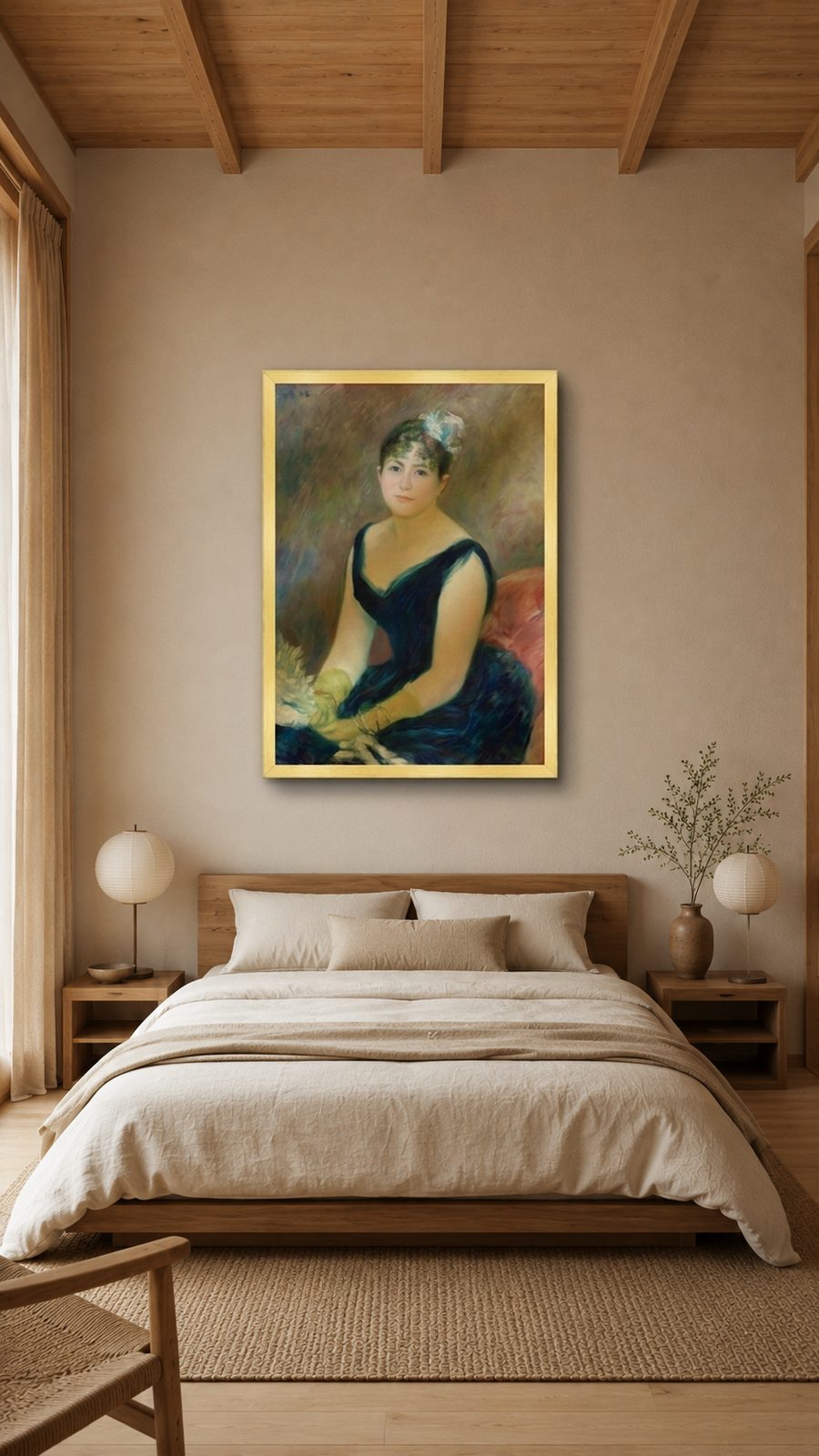
A wall you never see head-on
The wall behind a bed doesn't get looked at like the others. Standing, you catch it for a second, on your way in, at an angle. Lying down, you don't see it at all. Sitting in the bed, or from the doorway, you see it cropped by the headboard.
That leads to a simple, counterintuitive rule: the bottom of the image doesn't do any work. Everything that matters in the piece should sit in its upper half, because the lower half will be hidden by the pillows half the time anyway.
The height, measured from the headboard
The 155 cm rule doesn't apply here. The reference point is the headboard: 20 to 25 cm between its top and the bottom of the frame. Less, and the two objects visually touch and the whole thing looks cramped. More, and the image drifts off and floats alone at the top of the wall.
Without a headboard, measure from the mattress: allow 65 to 75 cm between the top of the mattress and the bottom of the frame.
The size follows the bed, not the wall
The width of the piece should sit between half and two-thirds the width of the bed. On a 140 cm bed, that's a piece between 70 and 93 cm wide: the 50 × 70 cm hung landscape, or the 75 × 100 cm portrait if the ceiling allows.
On a 160 or 180 cm bed, one 30 × 40 cm piece becomes a postage stamp. Two honest options: move up to the 75 × 100 cm, or commit to a pair of matching sizes, spaced 8 cm apart, centered on the bed's axis.
A calm image, not an empty one
A bedroom asks for rest, which doesn't mean bland. A piece too pale on a bright wall disappears, and a wall with no anchor is more restless than a wall with a strong image.
What works: a figure or motif with its own density, in a palette close to the room's textiles. Natural linen, ecru, pale wood call for warm tones, earth colors, and muted greens. They don't hold up well against electric blues and hard contrasts.
Why this Renoir belongs here
Madame Léon Clapisson, painted in 1883, is a portrait built exactly the way this wall requires: the face and torso fill the upper half, the lower half dissolves into the deep blues of the dress. Cropped by pillows, it loses nothing.
On metallic sheet, the blues keep their depth and the skin tone catches the morning's low light. Natural oak frame, to stay in line with the room's wood, hand-framed in Europe.