Composing several paintings above a sofa
One painting above the sofa is a settled question. Three is a question of rhythm: which piece leads, how much space between the frames, and where the composition stops before it spills across the wall.
A question that comes after the first
In short: one painting leads, two accompany it, all aligned on one low line, 5 to 8 cm between frames and no wider than the sofa.
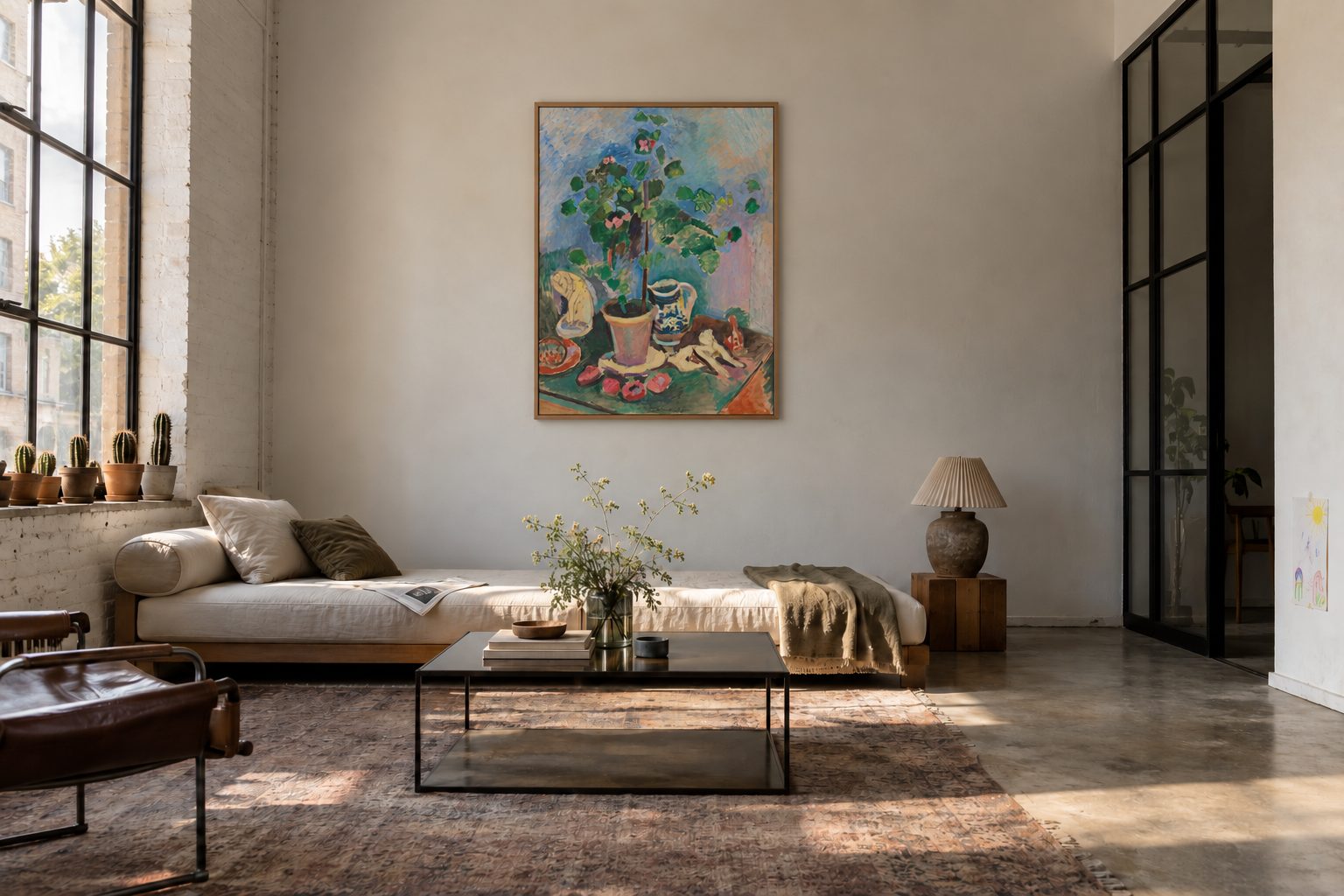
A low daybed under a studio's steel framed glazing, whitewashed brick in patches, a worn rug and a row of potted cacti on the windowsill: the room already has its first painting, the one that settled the question of size and height. What follows is a different question: adding a second piece, then a third, without the wall turning into an improvised museum hang.
Composing with several works changes the logic. One painting centres on the sofa. Several paintings form a block, and it is that block that needs centring, not each piece taken on its own.
The work: a bouquet in Matisse's studio
Henri Matisse painted this geranium still life in 1906, in the middle of his Fauvist years: a potted plant, a jug and a dish of fruit on a table, in a palette of bold blues and greens that refuses classical shading. The canvas now belongs to the Art Institute of Chicago, in the Joseph Winterbotham Collection. Museum record: Art Institute of Chicago.
The rule that holds a trio together
One piece leads, the other two accompany it: that hierarchy stops the eye from hunting for a centre that does not exist. This Matisse, with its bold colour, holds the lead role well.
The two companions belong to the same register, not the same subject: a quieter floral still life, such as Flowers in a Glass by Bosschaert, and something more pastoral, such as Spring Flowers by Monet, are enough to hold the group together without making it monotonous.
Alignment runs along the bottom edge, not the centres: all three frames rest their foot on the same imaginary line, about 20 cm above the sofa back, and that shared low line reads as one gesture rather than three separate hangs.
Three checks for a composition that doesn't drift
1. The total width of the composition, frames and gaps included, never exceeds the sofa's own width: beyond that, the eye has to turn the head to take it all in, which breaks the sense of one block.
2. The gap between two frames stays narrow, around 5 to 8 cm: any wider and each piece regains its independence, turning the wall back into three separate hangs rather than one composition.
3. The centre of the whole block, not of each painting, sits at 1.60 m from the floor, standing eye height.
4. Only one piece stands out in size within the trio: if all three frames look nearly equal, the eye no longer knows which one to look at first.
If you only have one painting today
Nothing requires hanging all three pieces on the same day. Choosing a first painting above the sofa is still the right first step, alone and well centred: a multi-piece composition can follow later, built around that first hang as its anchor.
A myth or a denser scene, like the one Moreau sets above a sofa, works very well alone but suits a trio less: its density wants air around it, not two neighbours.
Size and frame
The painting exists up to 75 x 100 cm, but the lead piece of a trio does not need the largest size: 50 x 70 cm leaves enough room for the two companions, so the wall does not turn into one canvas flanked by two accessories.
A slim, natural moulding, no mount and no margin, the same construction behind every Maison Soleil print: the three frames of the trio gain from sharing that same moulding profile, even if the finishes differ, so the eye reads one group rather than three separate sources.
Do the three frames need to match?
No. The moulding's profile and width should stay the same from frame to frame, but the tone can vary: natural oak for the lead piece, black for a companion, without breaking the group as long as the moulding keeps the same thickness everywhere.
How much space between the paintings?
About 5 to 8 cm between two frames: enough for each piece to breathe, little enough for the eye to read them as one gesture rather than three separate hangs.
How many paintings before it's too many?
Three pieces above a standard sofa stay readable at a glance. Beyond that, the composition needs a wall wider than the sofa itself, or it starts encroaching on walking space or a neighbouring window.