Mythological art above the sofa?
Mythological scenes have a reputation for being too much for a living room. That's true of the bad ones. The great ones, like Gustave Moreau's Hercules, do the exact opposite: they hold the wall and leave the room at peace.
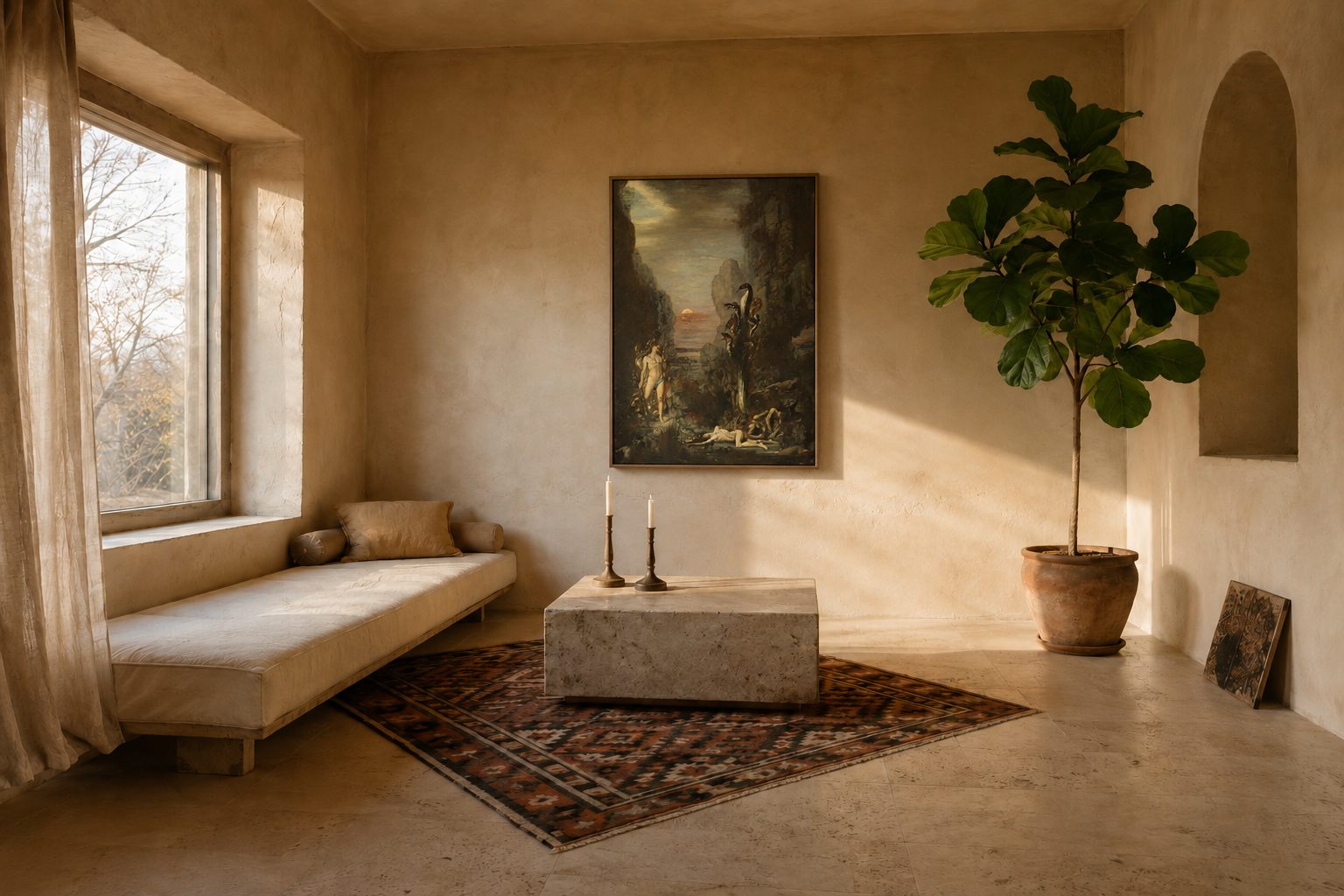
What a neutral wall is waiting for
A sand, linen, plaster, pale-wood living room is restful and runs exactly one risk: blandness. Everything matches, nothing happens. That's precisely the wall that calls for a dense image, one with something to tell.
A mythological scene does that job better than any landscape: it brings figures, drama, verticality. And because the rest of the room stays calm, it doesn't overload anything. The balance holds: the room soothes, the image intensifies.
Choosing the right myth
Not every mythological scene works on a wall. A twenty-figure battle turns unreadable at 50 × 70 cm. What works is the simple confrontation: one figure, one adversary, a face-off you understand from across the room.
Moreau's Hercules is a perfect example: the hero standing, the hydra reared up before him, and a silence between the two. You read the scene in a second, then spend years discovering its details.
Verticality, the sofa's ally
Above a sofa, the common mistake is an image too horizontal, one that doubles the line of the backrest and flattens the whole composition. A vertical format brings back the height the room lost when everyone sat down.
Center the image on the sofa's axis, with the center around 1.60 m off the floor, leaving 25 to 30 cm between the backrest and the bottom of the frame. One piece only: a face-off isn't meant to be shared.
The frame, deliberately understated
At the Salon of 1876, Moreau's Hercules hung in a wide, gilded, coffered frame. At home, a thin moulding, natural oak or black, is enough: the print's metallic sheet already carries the light that gold once supplied.
On a sand-toned wall, oak extends the room's tones and lets Moreau's deep red sky do its work.
The piece: Hercules and the Lernaean Hydra
Gustave Moreau painted this Hercules for the Salon of 1876: the second of the twelve labors, the marsh at Lerna, the many-headed hydra reared over the bodies of those who failed, and the hero standing still, watching before he strikes.
The print is made from the Art Institute of Chicago's own museum-resolution scan. On metallic sheet, the red sky and pale flesh tones take on a depth that ordinary paper can't render.