What to hang in a narrow hallway
A hallway is walked through, not viewed from afar. A Hammershøi from the Art Institute of Chicago to show which size, height and frame to choose when you cannot step back.
The short answer
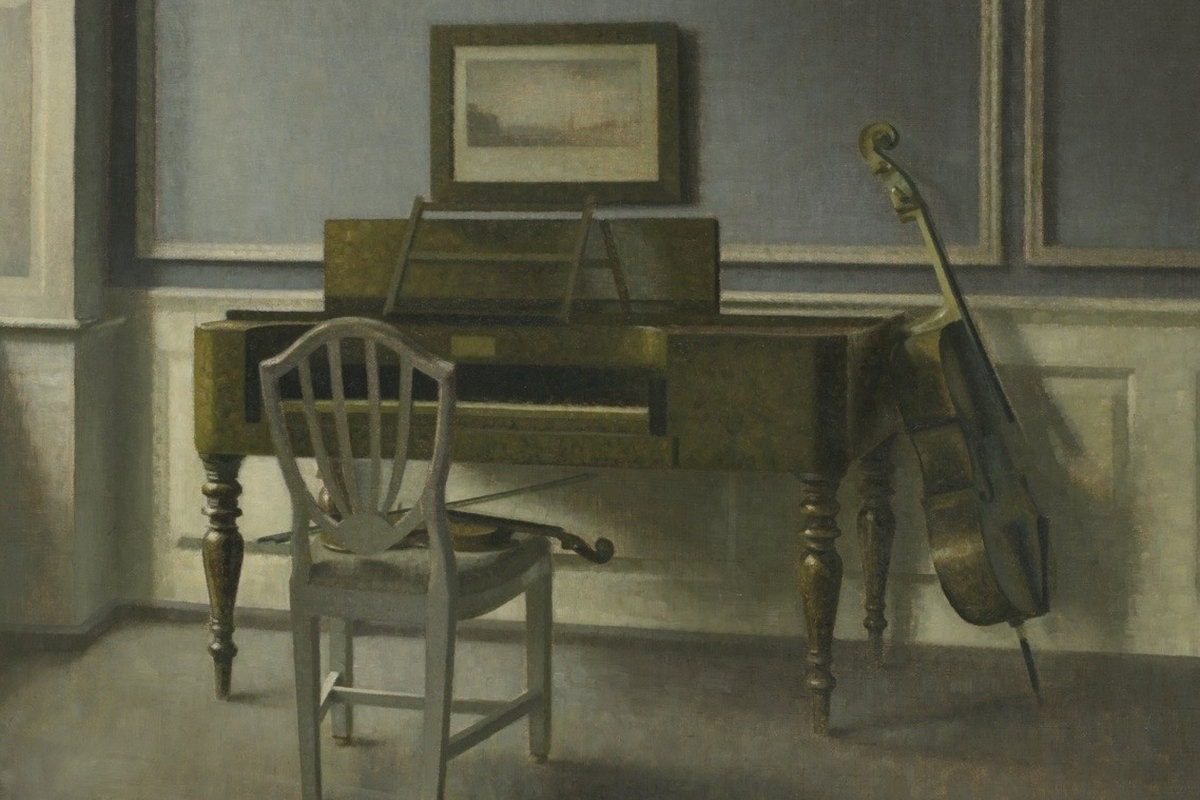
In a narrow hallway, hang small and at eye level. Vilhelm Hammershøi's Interior. The Music Room, Strandgade 30 at 40 × 50 cm, €135 shipping included, the centre of the frame at 1.60 m, on the longest wall, a third of the way in from the entrance. A natural oak frame, silver foil.
A large format does not read there: you see it at an angle, from a metre away, without ever stepping back.
Why avoid a large format in a hallway?
A hallway is walked through. You see the picture while moving, from the side, at a metre or less, and the eye never takes in the whole. A 75 × 100 measures about 79 × 104 cm with its 20 mm moulding: in a narrow passage it sticks out into the traffic without ever being seen in full.
The practical rule is simple: the viewing distance is about the width of the hallway. Take the size you can grasp at a glance from that distance.
Which size for which hallway width?
The Hammershøi comes in all four catalogue sizes. Here are the markers, to adjust to your wall:
| Hallway width | Size | Price, shipping included |
|---|---|---|
| Under 90 cm | 30 × 40 cm | €109 |
| 90 cm to 1.20 m | 40 × 50 cm | €135 |
| Over 1.20 m | 50 × 70 cm | €165 |
Why this painting in a hallway?
In 1907 Vilhelm Hammershøi painted an almost empty room: an old piano, a grey chair, a cello leaning on the wall, a violin on the seat, a small framed picture above the instrument, blue grey panelling. The title gives the address, Strandgade 30, the Copenhagen apartment where he lived.
It is a painting with depth of its own: a hallway that ends on a silent room extends by one more step. The Art Institute of Chicago holds the original, an oil on canvas of 70 × 59 cm (museum page); the 40 × 50 print reproduces roughly 70% of that scale.
At what height and where on the wall?
The centre of the frame at 1.60 m, as everywhere in this journal: in a hallway you look standing and walking, so no lower. On a long wall, place it a third of the way in from the entrance, where you slow down, at a bend or in front of a door, rather than in the middle.
Avoid the wall that faces a window or a glazed door: the acrylic gives a soft, low reflection, but a hallway often has a single light source, and it ends up in the glass.
Which frame and foil for a Hammershøi?
Natural oak, 20 mm profile, no mount: the image touches the wood and the frame takes no needless width in a narrow passage. Its tone picks up the olive green of the instrument.
For the foil, silver: a cool reflection that makes greys and blues crisper, the foil suggested for northern works (materials in detail). A Hammershøi is made almost entirely of greys: that is where the difference shows.
- Size: 40 × 50 cm if the hallway is between 90 cm and 1.20 m wide.
- Height: centre of the frame at 1.60 m.
- Place: a third of the way in from the entrance, on the longest wall.
- Frame: natural oak, 20 mm, no mount.
- Foil: silver.
And the hall, or a hallway with mouldings?
A hallway often starts with an entrance: for that wall, read what to hang in an entrance. In an older apartment with mouldings, the hallway follows the same logic as the living room, see what to hang between mouldings. Making and delivery take five working days (delivery).
Frequently asked questions
Which picture size for a narrow hallway?
The 30 × 40 cm (€109) under 90 cm wide, the 40 × 50 cm (€135) between 90 cm and 1.20 m, the 50 × 70 cm (€165) beyond. The marker: you should grasp the picture at a glance from a distance equal to the width of the hallway.
At what height do you hang a picture in a hallway?
The centre of the frame at 1.60 m from the floor. In a hallway you look standing and walking, so no lower. On a long wall, place it a third of the way in from the entrance rather than in the middle.
Can you hang several frames in a hallway?
Yes, provided you line them up on the same horizontal axis, with an even gap, and keep to one size. A single well placed frame beats a row of mismatched ones in a narrow passage.
Is the Hammershøi print faithful to the original?
It comes from the Art Institute of Chicago's public domain file (CC0), printed edge to edge on a 350 g metallic foil sheet. The original is an oil on canvas of 70 × 59 cm; the 40 × 50 print reproduces roughly 70% of that scale.