What painting for a Haussmannian apartment
Moulded cornices, a marble mantel, herringbone parquet: the decor is already written. The question isn't what to add, it's where to put the one thing that's missing.
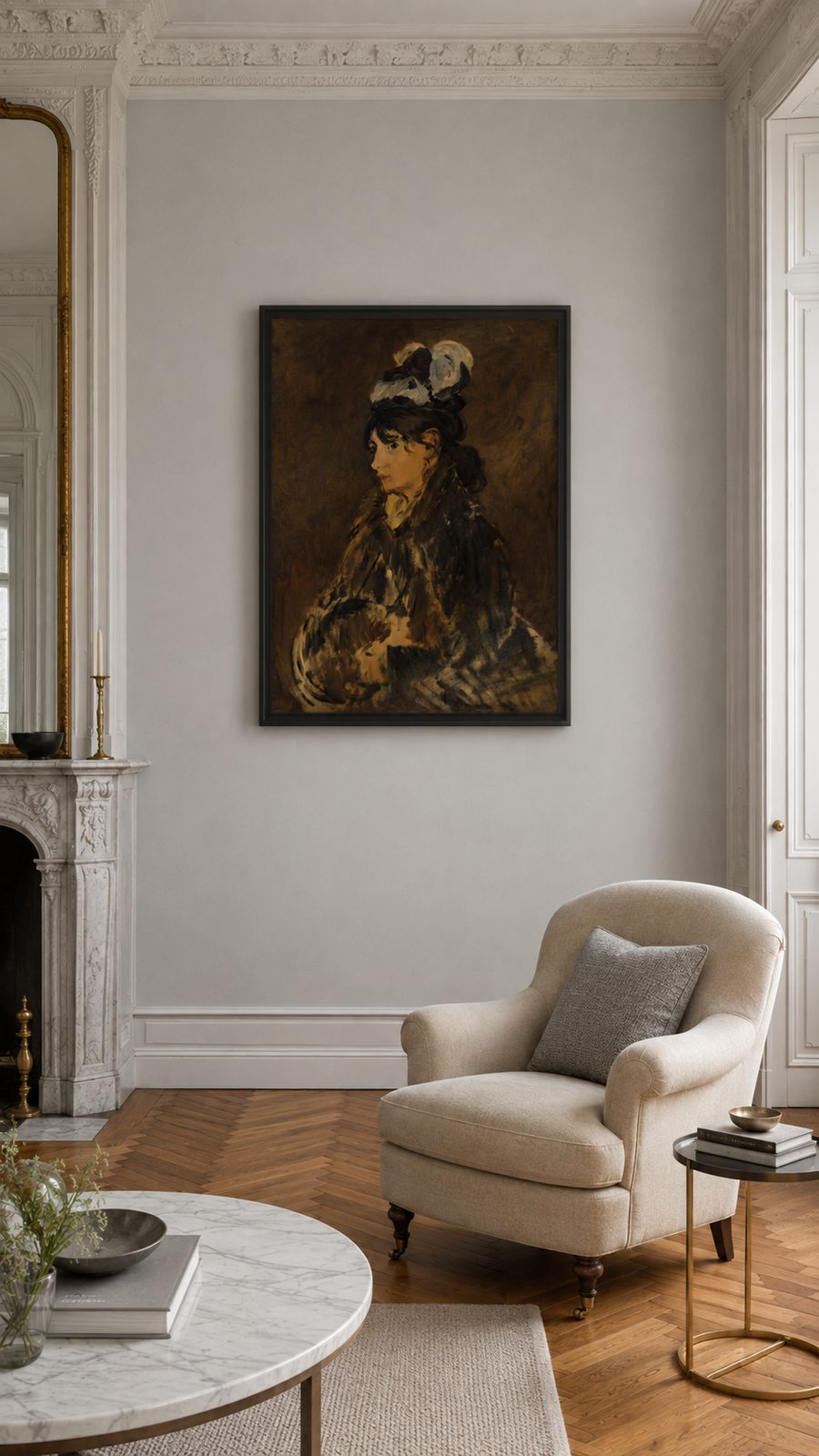
The wall is already furnished
A Haussmannian apartment comes with its own ornament: a cornice, often a dado rail, sometimes an overmantel mirror. The wall isn't a free surface, it's a composition that existed before you and already has its own horizontal lines.
The classic mistake is to treat this wall like a blank wall in new construction and center the image across its full height. The painting ends up wedged between two mouldings, equidistant from both, and the eye reads an object stuck in a box rather than a work that's been hung.
The right height isn't the middle of the wall
The rule that works in these rooms: center of the piece at 155 cm off the floor, not the middle of the wall. Under a 3.20 m ceiling, those two points are far apart, and 155 cm is the right one, because it's eye level.
Above a fireplace, raise it slightly: 25 to 30 cm above the mantel shelf, no more. Beyond that, the painting floats and the fireplace loses its role as a base. Below it, the two objects compete for the same zone.
One piece, sized generously
These walls don't take well to multiplication. Three small pieces lined up between mouldings read as a frieze, and a frieze competes directly with the cornice above it. One single piece, on the other hand, converses with the ornament instead of doubling it.
Size matters: below 40 × 50 cm, a single piece on a Haussmannian wall reads as timid. The 50 × 70 cm is the right starting point, the 75 × 100 cm holds effortlessly above a sofa or a mantel.
A gold frame, without irony
Gold has a bad reputation because people associate it with pastiche. In a bright Haussmannian room, it does exactly what's asked of it: it picks up the warmth of the parquet and answers the off-white of the mouldings, without imitating anything.
The safe alternative remains natural oak, which echoes the parquet more literally. Black also works, provided another black already exists in the room: a pendant light, a window handle, a mirror frame.
Why this Manet belongs here
Berthe Morisot with a Muff was painted in 1877, a few streets from buildings like these. The background is dark and detail-free, the figure is bright and compact: an image that reads from across the room, exactly what a through-living-room demands.
The print is made on metallic sheet, so the greys of the background keep their depth while the highlights of the dress catch the light from the window. Hand-framed in Europe, delivered ready to hang.