A portrait that holds your gaze
Some paintings decorate, others watch. The portrait of Ira Aldridge painted by John Philip Simpson in 1827 belongs to the second kind, and that's exactly what earns it a place in a living room.
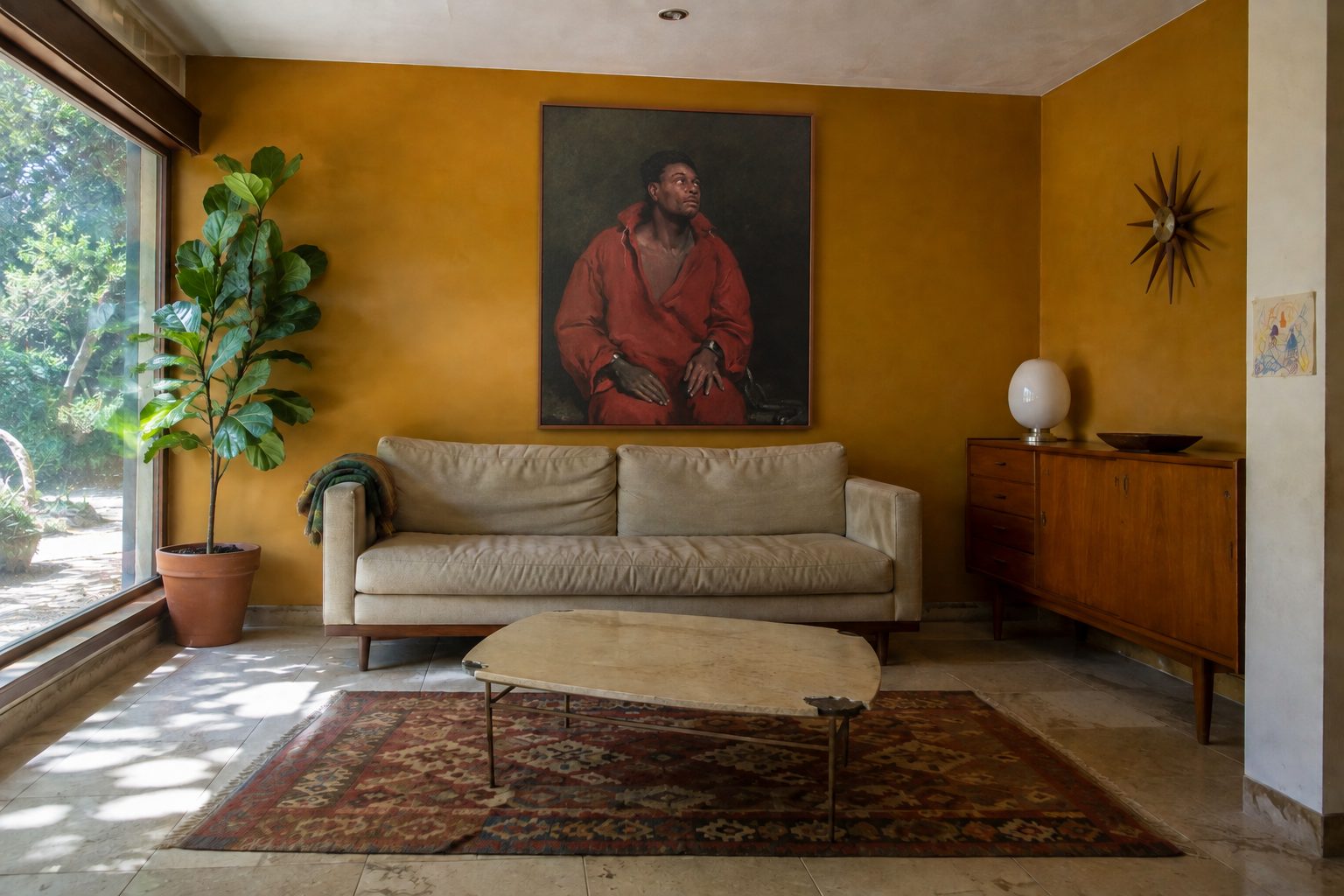
Design loves gravity
A 1950s living room, teak, brass, clean lines, is an extremely polite kind of decor: everything is designed, nothing spills over. What it almost always lacks is a counterweight. A grave, human image, one that keeps the whole room from being merely elegant.
That's why modernist interiors carry old paintings so well. Clean lines frame the emotion; the emotion keeps the lines from spinning empty. Each does the other a favor.
The piece: a man, not a motif
The Captive Slave was painted in London in 1827 by John Philip Simpson. The sitter is Ira Aldridge, a New York-born actor who settled in England, one of the first great Black tragedians on the European stage. He poses as a captive, wrists chained, gaze raised, at the very moment Britain was debating the abolition of slavery.
The painting is an argument: a portrait of total dignity, painted to move a country. Hanging it at home isn't decorating, it's making room for that gaze, and for what it stands for.
The large size, without hesitation
This portrait is available up to 75 × 100 cm. On a living room's main wall, that's the right size: the figure approaches life scale, and the presence becomes that of a person in the room, not a vignette.
Center it alone on its wall, with the center of the image at 1.60 m. Facing the sofa rather than above it: this is a painting you look at, as much as it looks at you.
The frame and the sheet
A thin black moulding, understated, is the only one that fits here: it holds the size without adding anything. The room's teak and brass don't need another gold echo.
On metallic sheet, the dark background keeps its depth and the red shirt takes on an almost physical light. The print is made from the Art Institute of Chicago's own museum-resolution scan.
Living with it
We're sometimes asked whether an image this serious gets heavy day to day. Experience says the opposite: the images that get heavy are the empty ones, the ones you stop seeing after a week.
A portrait with this much force changes with the daylight and with whoever's looking at it. That's exactly what a painting should be able to do.