Corot's Interrupted Reading in a country living room
A lime-washed wall, a velvet sofa, a woman looking up from her book. Corot's Interrupted Reading doesn't need a grand salon to belong, just a quiet wall and the right height.
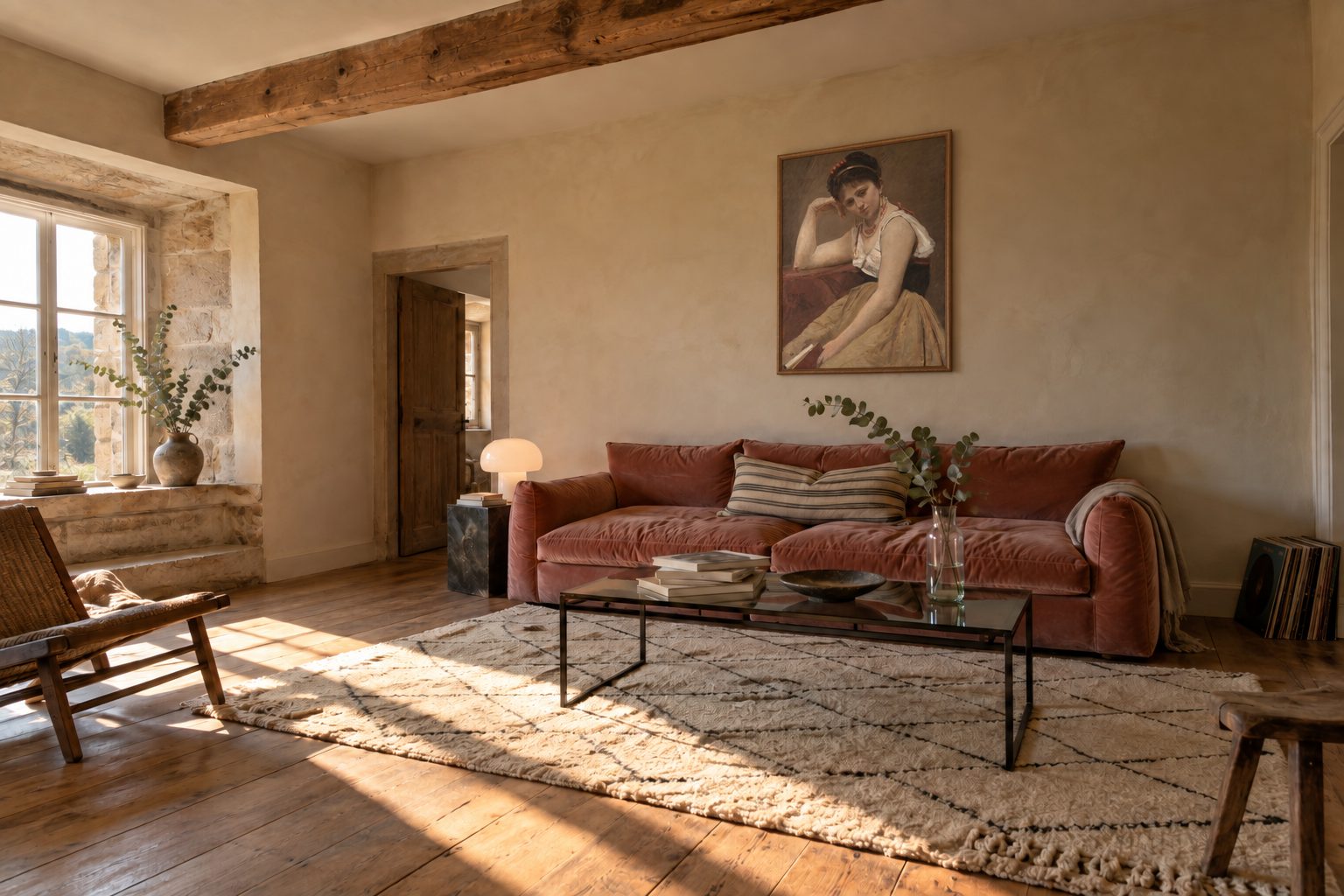
A room that calls for a face
A country living room with lime-washed walls, an exposed beam and a deep stone window reveal already has all the character it needs: the materials do the work, and the afternoon light does the rest. What a room this mineral often lacks is a human presence, something that looks back.
A landscape would only add a second window. A portrait holds the room differently: it gives the eye one point to rest on, a figure that stays still while the light itself keeps moving across the floor all day.
The piece: a moment, not a pose
Interrupted Reading was painted by Jean-Baptiste-Camille Corot around 1870. A woman leans on one arm, her head resting on her hand, her book still open under the other: she has just looked up, mid-sentence. Corot paints a pause, not a formal sitting.
The painting belongs to the Potter Palmer Collection at the Art Institute of Chicago, and the print is made from the museum's own scan: the same muted colours, the same texture of paint even in the shadowed folds of the dress.
Where to hang it, and at what height
Not dead centre above the sofa: the stone window already pulls the eye to one side of the room, so the wall reads better if the painting takes the other half, on the most continuous stretch of lime plaster, behind the sofa's right arm rather than above its middle.
The rule stays the same from room to room: centre of the image at 1.60 m from the floor, standing eye height. Here that places the reader just above the sofa back, high enough to still read from the rattan chair across the room.
The size and the frame
The largest size, 75 x 100 cm, is right for this wall: the ceiling beam already gives the room height, and a smaller print would get lost next to a sofa this wide. At that size the figure approaches a real presence rather than a vignette.
A slim wooden moulding, no mount and no white margin: the image meets the wood exactly as the original meets its own frame. On 350 gsm metallic paper, the skin tones pick up a soft sheen while the dark reds and browns of the jacket keep their full depth.
Living with her
In the morning, low light comes through the stone window and does not yet reach the painting. By afternoon it crosses the room and just touches the bottom of the frame: the moment the scene reads best, when the painting's own light and the room's light come closest together.
An interrupted reader is neither stern nor talkative. She holds the wall without dominating it, and lets the room keep living around her, which is exactly what a painting should do in a room people actually use.