What painting above the sofa in a bright living room
A wide wall, low seating, plenty of light. The sofa wall gets it wrong more often than right, and it's almost always the same mistake.
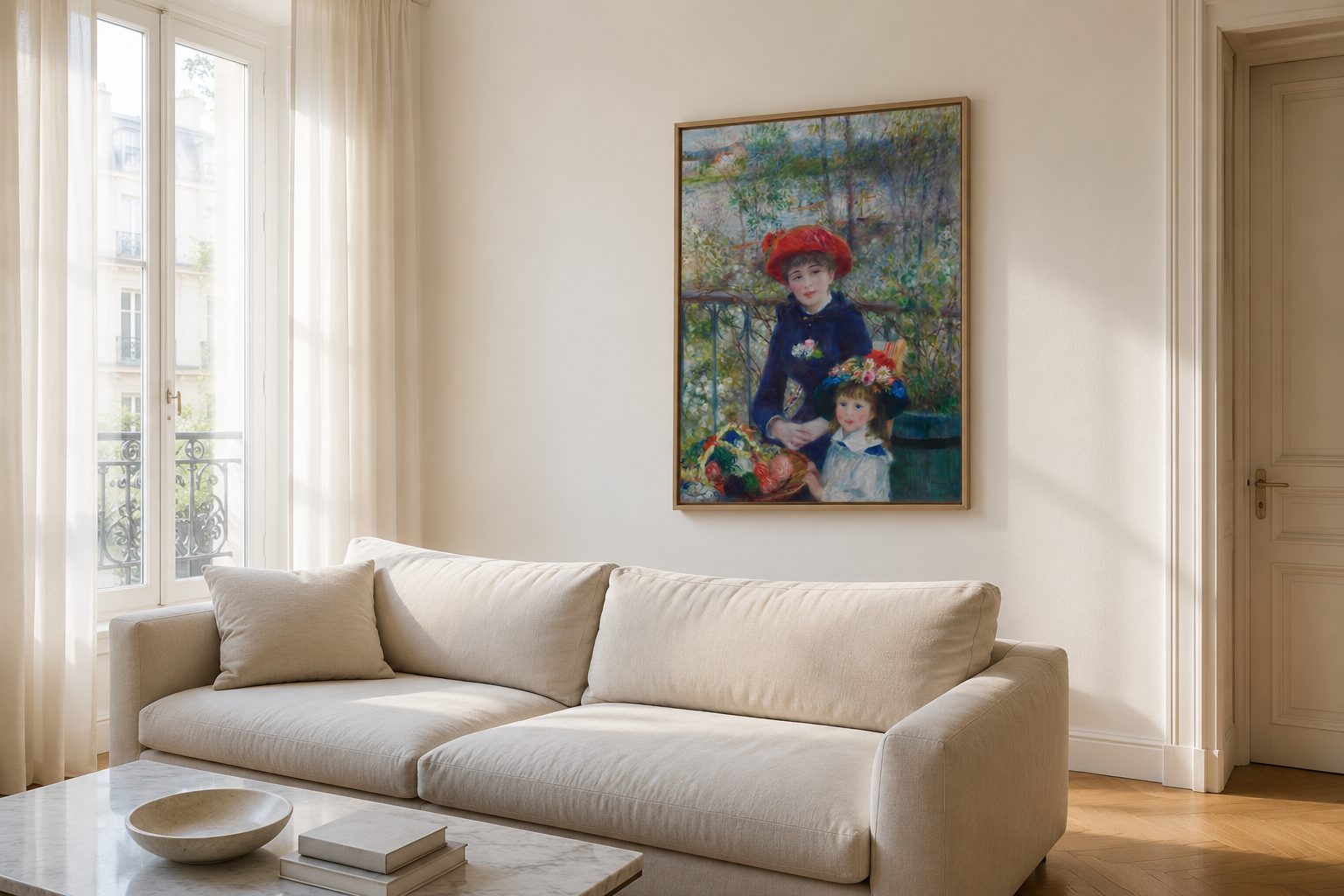
The hardest wall in the house
The sofa wall is wide, it's seen from below, and it's almost always empty. That's why we hang too small there. A piece chosen standing up, at arm's length, looks half as strong once it's hanging above a sofa that runs two meters or more.
The fix is arithmetic before it's decorative. Three measurements are all it takes, and they're easy to remember.
The two-thirds rule
What you hang should be about two-thirds the width of the sofa. A 220 cm three-seater calls for an image around 145 cm wide, alone or as a group. A 160 cm two-seater calls for about 105 cm.
The center of the image then sits 145 to 150 cm off the floor, that is, at the eye level of someone standing, not in the middle of the wall itself. This is the most common and most visible mistake: an image centered on the available wall always ends up too high.
Finally, leave 20 to 25 cm between the top of the backrest and the bottom of the frame. Less, and the painting and the sofa fuse into one block. More, and the image floats free and the wall takes over again.
Why a bright room can carry a dense image
A living room with off-white walls doesn't need calming, it needs a place to land. The eye crosses the room, reaches the window, and moves on. A dense image above the sofa finally gives it somewhere to stop.
Two Sisters (On the Terrace), painted by Renoir in 1881 on the terrace of the Maison Fournaise in Chatou, does exactly that with a single accent: the red hat. Everything else, the deep blue of the dress, the greens of the foliage, the river behind them, stays in a muted range that never fights the walls. It's an image that fills the space without raising its voice.
The Art Institute of Chicago, which holds the painting, identifies the elder sister as the young actress Jeanne Darlaud.
The size that fits this wall
Above a three-seater sofa, the 75 × 100 cm is the only one of our four sizes that can hold the wall on its own. That's not a catalogue coincidence: the 1881 canvas measures 100.5 by 81 cm, so the print reproduces it within a few centimeters of its original scale. What you hang is the size Renoir painted.
On a two-seater, or in an entryway, the 50 × 70 cm is the right scale. Below that, you're no longer thinking in terms of one piece but two or three arranged together, which is a different exercise and needs a more generous wall.
The frame, on a bright wall
On off-white walls, natural oak disappears and lets the metallic sheet do the work. Black, on the other hand, cuts into the image and hardens it: it suits a dark wall and rarely a bright one. Gilt echoes the gold of the sheet and ends up becoming one more object in the room, instead of a simple edge.
The eight frame tones are photographed side by side on the materials page, under the same light, which is the only honest way to compare them.