An old master in a modern interior?
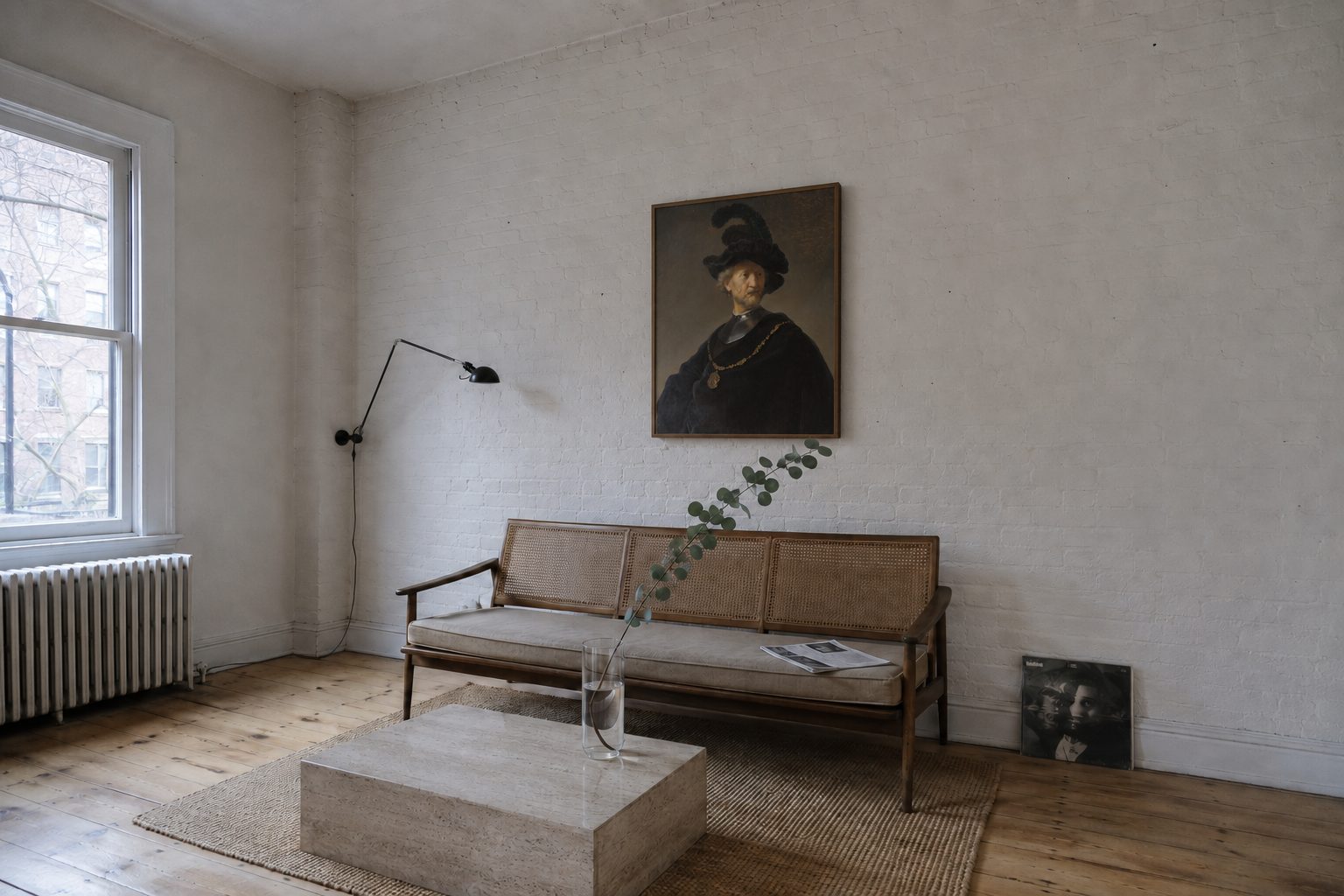
It's the question we get asked most, always with the same worry: won't it clash? Here's the answer, with a 1631 Rembrandt on a whitewashed brick wall.
The false problem of mixing eras
The worry is always the same: a 17th-century portrait in today's living room will look like a museum, or a costume party. What actually happens is the opposite. What reads as dated is the perfect match: the old painting in the old-style salon, chandelier and side table to match. The whole thing turns into a stage set.
In a raw room, whitewashed brick, worn pine, jute, that same painting becomes a singular object again. It stops illustrating an era and starts cutting through it. Galleries figured this out long ago: the plainest walls carry the richest paintings.
Why a dark portrait, specifically
On a bright, matte wall, a dark image does what no bright image can: it carves out depth. The near-black background of a Rembrandt portrait opens a hollow in the wall, like a window onto another kind of light.
And the face, lit from the side, does the rest. You see it from the sofa, from the table, from the entryway: it holds the room without ever raising its voice. The calmest interiors carry a gaze remarkably well.
The right size and height
An old portrait doesn't need to be monumental, it needs to be alone. On a three- or four-meter wall, a 50 × 70 cm centered at eye level, about 1.60 m at the center of the image, is more than enough. Nothing else on that wall: no shelf, no cluster of small frames around it.
If the wall is very wide, don't add more pieces, go bigger with one. Two old portraits side by side cancel each other out; one, slightly larger, wins.
The frame that doesn't cheat
The temptation is a heavy gilded, coffered frame, the museum kind. On brick, it turns the whole thing into pastiche. A thin moulding, black or dark walnut, under acrylic glass, lets the painting do its work and belongs, itself, to the present day.
That's the principle behind the whole house: the metallic sheet gives the depth, the frame stays quiet, and the contrast between centuries is what creates the style.
The piece: an old man and a gold chain
Old Man with a Gold Chain was painted around 1631, by a Rembrandt of about twenty-five. It isn't a commissioned portrait, it's a character study, a face worked out for its own sake, the steel gorget and gold chain pulled from the studio's prop chest.
The print is made from the Art Institute of Chicago's own museum-resolution scan. On metallic sheet, the chain and gorget do exactly what they already did on the canvas: they catch the light.