Where to hang a portrait in a country living room
A landscape looks at nothing. A portrait does, and that changes everything about where you hang it.
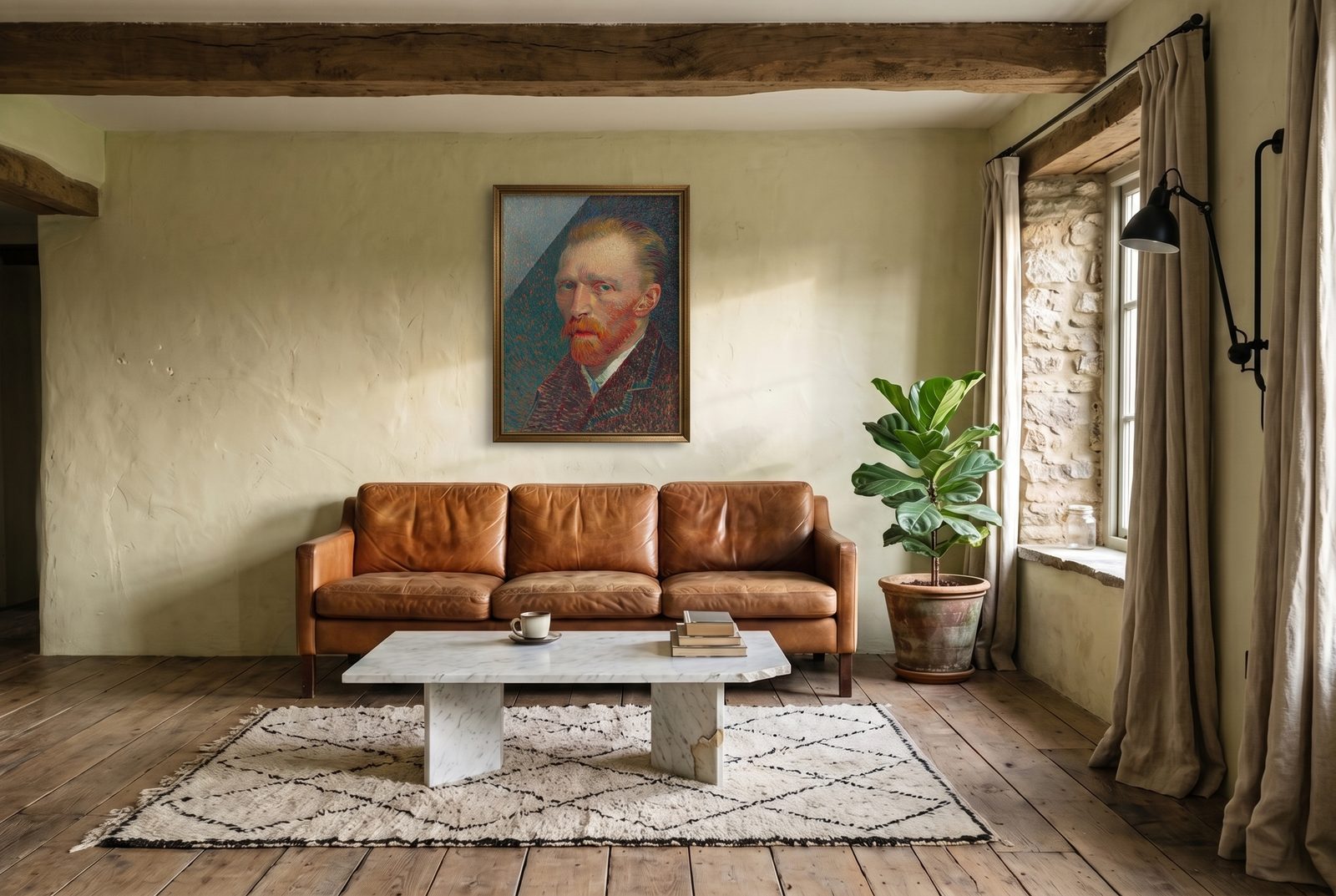
The only painting that looks back at you
A landscape looks at nothing. Neither does a still life. A portrait does, and that changes everything about where you hang it. The two-thirds rule and eye-level height still set the size and the position on the wall, and they still hold here. But a painted face adds a constraint the other genres don't have: the direction of its gaze.
Hung in the wrong spot, a portrait ends up staring at a door, a lamp, or the empty space above a chair no one sits in. That's not a small detail. It's often the first thing a visitor notices, without quite being able to say why the room feels slightly off.
Where the gaze should fall
The rule is simple to state, less simple to apply: the portrait's gaze should fall on the spot where people sit or pass by, never on a bare wall or a window. Facing a three-seater sofa, a front-facing portrait, centered, looks straight at whoever sits down. It's the safest setup, and the easiest to get right the first time.
This self-portrait, painted by Van Gogh in 1887, works especially well here: the face turns almost straight ahead, the eyes angled slightly to the side but the torso upright, giving a gaze that catches you without ever staring hard. Neither too direct, nor evasive.
A rustic interior, a dense touch
A country living room with limewashed walls, an exposed beam, and a deep stone window reveal poses a different question than a bright Haussmannian salon: the wall's texture is already present, uneven, alive. A smooth, cool image gets lost there. A dense, choppy, vibrating brushstroke like Van Gogh's from this period suits it instead: it answers the wall's texture rather than fighting it.
This version of the self-portrait, held by the Art Institute of Chicago in the Joseph Winterbotham Collection, dates from the summer of 1887 in Paris, a period when Van Gogh often painted himself for lack of a paying model. The fragmented, almost pointillist brushwork owes much to his interest in the Neo-Impressionists at the time.
The size for a face, not a scene
A wide scene, a landscape or a multi-figure composition, needs width to hold a sofa wall. A portrait works differently: its presence comes from proximity, not scale. The 75 × 100 cm, at 259 €, still works on a large bare wall, but it turns a face into an almost life-size presence, which isn't always what you want in a living room.
The 40 × 50 cm, at 135 €, or the 50 × 70 cm, at 165 €, keep a portrait's character as an object you look at rather than decor that fills the wall. The smallest size, 30 × 40 cm at 109 €, suits a secondary wall, a hallway or a study, where you meet the gaze up close.
The frame, on a wall with texture
On a limewashed, uneven wall, a frame that's too smooth or too dark competes with the surface instead of blending into it. Warm tones, natural oak or gold metallic sheet, absorb the uneven raking light better than a matte black frame, which is more at ease on a flat, bright wall.
The eight available tones are photographed side by side, under the same light, on the materials page: it's the only honest way to compare an oak frame and a gold one before deciding.